Duration: 21 Nights/ 22 Days
Tour Destinations: Delhi – Shillong – Cherrapunji – Guwahati – Kaziranga – Majuli – Ziro – Mon – Mokokchung – Tuophema - Kohima
Highlights: Northeast India Panorama tour takes you to one of the most exotic destinations, not just in India but in the world. It overlaps two global biodiversity hotspots, the Eastern Himalaya and Indo‑Burma, giving it rare flora, fauna and landscapes. It is home to over 200 distinct tribes and communities, each with its own languages, textiles, festivals and architecture, creating a cultural mosaic. This is what makes Northeast India an unusually concentrated region of natural and cultural diversity.
One gets to discover the capital city of India, ‘Delhi’, which has been the nerve center of political activities for the last 5,000 years, and then explore the waterfalls and living root bridges of Meghalaya, the sacred Kamakhya Temple, cruise the mighty Brahmaputra, and enjoy the serene Satras and river‑island landscapes, plus rhino and elephant safaris in Assam. You will also visit Nagaland’s State Museum, which showcases the various cultures of Nagaland, and a poignant World War II cemetery.
A visit to Arunachal and Nagaland will expose you to tribes like Apatani, Konyak, Ao, and Angami Nagas and their cultures. The remote villages, famed for traditional tattoos, wood and bamboo architecture, colourful textiles, monumental log drums and vivid folklore of valor and head hunting will give you an insight into these tribe’s rich daily life, history and culture. Overall, this tour will offer a rich blend of nature, living tribal heritage and history across some of Northeast India’s most atmospheric destinations.
Day 01 – Arrive Delhi
Day 02 – Full-day sightseeing tour of Delhi visiting Qutab Minar, Humayun’s Tomb, Government buildings, Jama Masjid, rickshaw ride in Chandni Chowk and Raj Ghat (Mahatma Gandhi Memorial).
Day 03 – Morning fly to Guwahati and drive to Shillong.
Day 04 – Full-day sightseeing tour of Shillong visiting Don Bosco Museum, Burra Bazar, or Idew Market and the Archery a unique feather or Shillong.
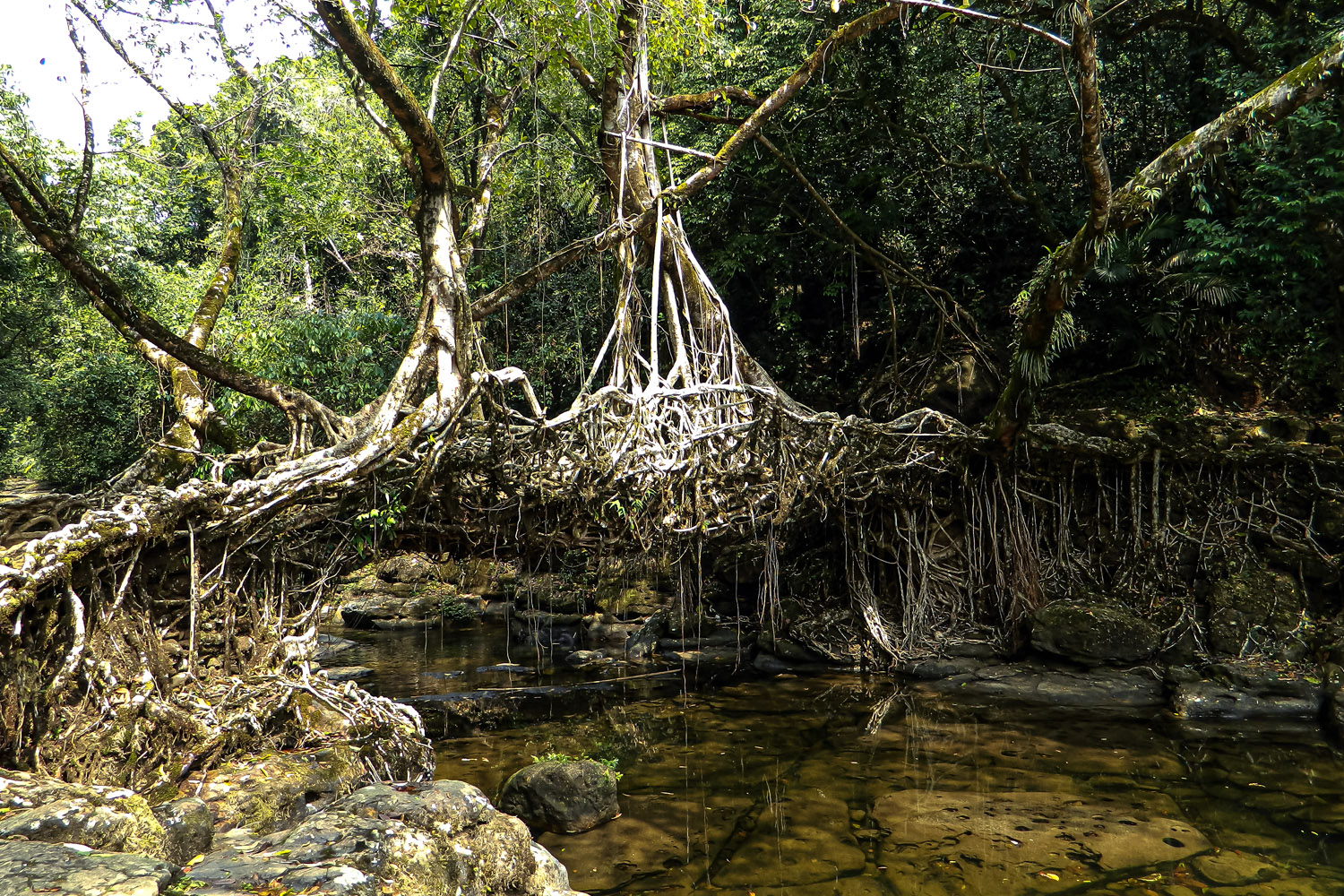
Day 05 – Morning drive through a very picturesque landscape to Mawlynnong (90 Km) to visit the cleanest village in Asia. Also, visit the ‘Living Root Bridge’ of Riwai en route. Later drive to Cherrapunji (70 Km) the wettest place on earth.
Day 06 – Full-day explore Cherrapunji. Visit Mawsmai Cave, and walk around the surrounding area enjoying numerous waterfalls and view enjoy the view of plains of Bangladesh.
Day 07 – Morning, depart Cherrapunji for Guwahati (150 Km) stopping by en route to visit Elephant Waterfalls and Umiam Lake. Afternoon visit Kamakhya Temple. Evening take a sunset cruise on the mighty Brahmaputra River.
Day 08 – Morning drive to Kaziranga. Afternoon game viewing drive in Kaziranga National Park.
Day 09 – Morning and evening game drive in Kaziranga National Park.
Day 10 – Early morning elephant ride in Kaziranga National Park. Later in the morning drive to Nimatighat to take a two-hour ferry to Majuli the largest freshwater island in the world and home to the Missing tribe. Afternoon, explore Majuli. Evening, visit a Satara the hub of art, culture, and religion activities in Assam.
Day 11 – Morning, drive to Ziro, Apatani tribal region in Arunachal Pradesh.
Day 12 – Full-day, explore Apatani tribal villages in the surrounding areas. Know once for their tattooed faces impressive ornaments and headgear.
Day 13 – Morning, explore surrounding tribal villages. Late morning drive Dibrugarh (250 Km).
Day 14 - Morning, drive to Mon (185 Km) the land of Konyak Nagas visiting Shivsagar the old capital of Ahom dynasty enroute.
Day 15 – Morning, proceed on an excursion to Longwa village (42 Km one way) in the Indo-Myanmar border which is home to the Konyak Naga tribe, an erstwhile, headhunters who were very good with gunsmithing, iron-smelting, brass works, and gunpowder-making.
Day 16 – Morning, drive to Mokokchung (264 Km) the land of Ao Naga, the largest tribal group in Nagaland.
Day 17 – Full-day, explore Ao Naga villages to learn more about the history, culture, and life of this tribe. Ao Naga’s are known for making impressive materials made out of bamboo, colourful shawls and wraparounds, headgear, etc. Visit will include a museum, morungs (boy’s dormitory), log-drums, and scenic landscapes.
Day 18 – Morning drive to Tuophema (120 Km) land of Angami Naga tribes visiting one of the oldest Ao Naga villages enroute which used to be the epicentre during the headhunting days. Afternoon explore the village knowing more about the history, culture, tradition of this most fierce and respected Naga tribes for their bravery.
Day 19 – Morning at leisure or explore the village to know more about Angami Nagas. Early afternoon drive to Kohima (40 Km) the hinterland of Angami Nagas and famous for World War II history, visiting State Museum in Kohima town.
Day 20 – Morning excursion to Khonoma village (20 Km – one way), a picturesque hamlet known as “Asia’s first Green Village” is famous for its sustainable living.
Afternoon sightseeing tour of Kohima visiting World War II Cemetery and Kohima Cathedral.
Day 21 – Morning excursion Kasima village (15 Km – one way) which boasts of model a Heritage Village, cultural hotspot that showcases the rich traditions and vibrant lifestyle of Nagaland’s 17 tribes.
Day 22 – In time drive to Dimapur (64 Km) airport to board the flight for Delhi. Arrive Delhi and connect the international flight.
Day 01 – Arrive Delhi
Arrive IGI airport Delhi. Met by our representative upon arrival at the international airport and transferred to the hotel.
Overnight at hotel.
Day 02 – Delhi
An orientation and tour briefing in the morning is followed by a full-day sightseeing tour of Old and New Delhi.
In Old Delhi visit Jama Masjid - the last architectural extravagance of the emperor Shah Jahan, which he built shortly after the completion of Red Fort. The largest mosque in India, its courtyard and surroundings can accommodate 25000 devotees to offer prayer at a time. The visit will be followed by a cycle rickshaw ride in Old Delhi. A cycle rickshaw rides through the narrow alleyways of Chandni Chowk and observing daily activities there is an experience by itself. A flamboyant bazaar (marketplace) once for the elite and the novels of the Mughal court, it today is a bustling wholesale market, the largest in Asia. Also, visit Raj Ghat – the cremation site of Mahatma Gandhi referred to as “Father of the Nation”.
On finishing the visit to Old Delhi, drive towards New Delhi stopping by en route briefly to explore the Central Delhi area with colonial remnants. Indo-Saracenic architecture, large boulevards, and a good green cover mark the character of this area. Drive pass government buildings and India Gate built in memory of 70,000 Indian soldiers who lost their lives during the First World War fighting for the British. This arch built in 1921 is a prominent site in Delhi.
The sightseeing tour of New Delhi will cover a visit to Humayun Tomb, the pioneer of Mughal architecture in India. This 16th-century colossal monument is considered to be an early masterpiece that decisively influenced the design of the later Mughal architecture including the Taj Mahal. A fusion of Persian and Hindu architectural influence is visible in this monument. Built in the middle of a four-cornered garden it is one of the best-preserved Mughal monuments in Delhi. End the day with a visit to Qutab Minar. Built-in red sandstone during the early 13th century and standing 72.5 m tall, tapering from 2.75 m in diameter at its peak to 14.32 m at the base, it is not only one of the tallest towers of its time but the tallest brick tower in the world. The tower is ornamented with intricate stone carvings and the walls consist of verses from the Koran (the holy book of Islam). The Complex also hosts mosques and a 5th/ 6th-century BC Iron Pillar (in the courtyard of the mosque) which has not rusted even after 2000 years.
Overnight at hotel.
Day 03 – Delhi to Guwahati and Shillong
In time transfer to airport to board the flight for Guwahati. Fly Delhi/ Guwahati.
Arrive Guwahati airport and drive to Shillong (120 Km).
Arrive Shillong and check in at hotel.
Located at an altitude of 4,900 feet above sea level, Shillong, the capital of Meghalaya, is also popularly called the Scotland of the East. Lush green hills interspersed by undulating patches of highlands, dotted with enticing waterfalls and a very pleasant climate, make these hills one of the favorite destinations for its visitors.
Overnight at hotel.
Day 04 – Shillong
witness an archery lottery a unique lottery game in Shillong.
Don Bosco Museum - (closed on Sundays) which is a kaleidoscope of various cultures of entire northeast region. This seven-story building houses a wide collection of regional artwork, attires, accoutrements, handicrafts, ornamentation, photographs and weapons giving insight to the culture and traditions of the northeast India.
Cathedral of Mary Help of Christians – originally built by a Salvatorian from Germany in 1913 - a small wooden structure was gutted in a Good Friday fire in 1936. Present building was then built, which now is a seat of Bishop and principal place of worship of the over 300,000 strong Catholics of the Shillong Archdiocese.
Burra Bazar or Idew Market is one of the most interesting markets in Shillong. One can explore/ observe this local market endlessly as one gets to see many local characters.
Teer or the Archery Lottery is a unique and culturally significant lottery game based on traditional archery. The only legalized form of gambling in Meghalaya, the game involves two rounds each day where archers shoot hundreds of arrows at a cylindrical target. The winning number is the last two digits of the total number of arrows that hit the target. Players place bets on numbers between 00 and 99, often guided by dreams and local beliefs.
Overnight at Overnight.
Day 05 – Shillong to Mawlynnong and Cherrapunji
Morning, proceed for an excursion to Mawlynnong (90 Km) to visit India’s cleanest village, Living Root bridge at Riwai.
Mawlynnong – a drive through picturesque locales of the Eastern Khasi Hills (pine woods, undulating grasslands, and lush green hills) will take you to this small hamlet with about 75 households and 400 people. Dubbed India's cleanest village, it inspires surroundings with immaculately clean pathways lined by gardens on both sides, a traditional bamboo resort, and a thrilling skywalk.
Living Root Bridge of Riwai - just 3 km before Mawlynnong is Riwai village, home to the Living Root Bridge, a remarkable example of nature-assisted engineering by the Khasi tribe. Rubber tree roots are guided across rivers using hollowed bamboo trunks and allowed to grow strong over 20–25 years, forming sturdy bridges that can support up to 50 people. These sustainable, living structures adapt to soil erosion and can last 200–300 years. The roots form base spans and protective railings, with stones filling gaps, showcasing a centuries-old tradition of harmony between humans and nature.
Note: one has to walk downhill for 15 minutes to reach the bridge from the roadhead.
Continue driving to Cherrapunji (70 Km) on finishing the Mawlynnong visit.
Arrive Cherrapunji by late afternoon or early evening and check in at hotel.
Cherrapunji or Shora as it is locally called is well described as the wettest place on planet earth. Picture perfect locales dotted with numerous waterfalls, undulating highlands and greenery and bird’s eye view of plains of Bangladesh is what dominates landscape of the place.
Overnight at hotel.
Day 06 – Cherrapunji
Morning, proceed on a sightseeing tour of Cherrapunji visiting Mawsmai Cave and few of many viewpoints that commands panoramic view of surroundings hills, gorges and plains of Bangladesh.
Mawsmai Cave - one of the numerous caves found in Meghalaya which takes you to a lesser know side of the earth. As you move inside the cave you will notice dripping of water from the cave roofs and the formation of stalactites and stalagmites forming exotic figures, wonderful phenomena specially found in limestone caves.
Cherrapunji area boasts of numerous waterfalls which come to full life once the monsoon hits the region and they could be seen from strategic viewpoints. Some of them are as follows:
Nohkalikai Falls viewpoint - signature viewpoint for India’s tallest plunge waterfall here, dropping into a turquoise pool in a vast horseshoe-shaped gorge. On clear days you see the entire cliff face, surrounding forested plateau and distant ridgelines; in monsoon the roar and mist create a very immersive scene.
Thangkharang Park - cliff-edge park giving wide 180-degree views over the canyons and plains of Bangladesh, plus distant sight of the tiered Kynrem Falls.
Eco Park - open plateau-park developed as a “balcony” over Cherrapunji’s famed green canyons, with marked points for canyon, valley and Bangladesh plains views. You can also see waterfalls dropping off the escarpment, including streams that later form Nohsngithiang (Seven Sisters) Falls, plus a small stream and orchid house within the park.
Other popular viewpoint Mawsmai side that gives layered valley views and, in places, glimpses towards Bangladesh, often combined with a cave visit. Seven Sisters Falls area viewpoints (often clubbed with Eco Park or separate platforms) face a tall segmented waterfall line pouring down a vast cliff during monsoon, with sweeping valley scenery around.
Overnight at hotel.
Day 07 – Cherrapunji to Guwahati
Morning drive to Guwahati (150 Km) stopping by enroute at Umiam Lake.
Umiam Lake - just 15 km before Shillong on the Guwahati–Shillong Road near Barapani, is a vast man-made reservoir formed by damming the Umiam River in the early 1960s. Spreading across a 220 sq km catchment, it offers a serene, fjord-like setting with boating, kayaking, water-skiing and other water sports that make it a classic Meghalaya stop.
Arrive Guwahati and check in at hotel, followed by a visit to Kamakhya Temple.
Kamakhya Temple is a revered Shakti Peetha, where the goddess is worshipped in the form of a sacred yoni symbolising divine feminine power and fertility. Its 16th‑century Nilachal‑style beehive dome, multiple mandapas and sculpted panels reflect a long history of rebuilding by Koch and Ahom kings.
Overnight at hotel.
Day 08 – Guwahati to Kaziranga
Morning drive to Kaziranga (250 Km). Arrive Kaziranga and check in at your hotel.
Afternoon game viewing drive in Kaziranga National Park.
Kaziranga National Park – situated in the flood plains of Bramhaputra in Assam is often compared with African wildlife sanctuaries due to the quality of wildlife viewing here. Associated more commonly for conservation of endangered Great Indian one Horned Rhinoceros and harbouring largest population of them, this World Heritage Site boasts of one of the highest Tiger density apart from harbouring world’s largest population of Asian Wild Buffalo and last surviving population of Eastern Swamp Deer.
Apart its main predator Tiger one can expect to see leopard and lesser cats like Jungle and Fishing Cat etc. Main prey base here are deer species like Spotted Deer, Sambar, Hog Deer, Sambar, Swamp Deer, Hog Deer, Barking Dee and Indian Muntjac etc. Other mammals seen here are Asian Elephant, Sloth Bear, Wild Boar, Gaur, Asian Wild Buffalo, Common Indian Otter, Indian Porcupine, Eastern Mole, Large and Small Indian Civet, Pangolin Small Indian and Indian Gray Mongoose, Bengal and Golden Fox, Hog Badger, Orange-bellied Himalayan Squirrel, Malayan Giant Squirrel, Bristly Hare etc.
Primates seen here are Rhesus Macaque, Assamese Macaque, Capped Langur, Hoolock Gibbon, Slow Loris etc. Reptiles found in the park are Water Monitor, Indian Python, Common Cobra and famous King Cobra.
Kaziranga has been recognized by Birdlife International as an Important Bird area, over 525 birds are reported in Kaziranga of which some are highly endangered birds like Great Hornbill, Bengal Florican, Greater Adjutant, Pale-capped Pigeon, Baer's Pochard, Greater white-fronted Goose, Pallas’s Fish Eagle etc. Kaziranga is also a very good place to see vultures.
Overnight at hotel.
Day 09 – Kaziranga
Morning and evening game drive in Kaziranga National Park.
Overnight at hotel.
Day 10 – Kaziranga to Majuli
Early morning elephant ride in Kaziranga National Park.
Later in the morning drive to Nimatighat (100 Km) to take a two-hour ferry to Majuli. Arrive Majuli and check-in at hotel.
Afternoon, explore Majuli.
Shaped by the shifting channels of the Brahmaputra and its tributaries, forming a unique deltaic landscape of fertile alluvial plains, wetlands (beels), and sand shores, Majuli is not just a geographical marvel but a living cultural landscape where tradition, community, and nature are deeply intertwined. The largest inhabited river island in the world. It is home to a rich mix of ethnic communities with the Mising being the largest tribe. Right from the day of their settlement here, people of Majuli have been challenged by roaring force of nature, thus they have acquired the art of utilizing this mighty force of nature for their benefit. With arrival of Vaishnava saints of Assam, Majuli has become the nerve center of Assamese Religion, Art, Culture and Education and they have been preserving it as a living culture for the last five hundred years against all odds.
Evening, visit a Satara also a hub of art, culture, and religion activities in Assam.
Majuli’s satras are Neo‑Vaishnavite monasteries founded by Srimanta Sankaradeva, serving as spiritual, cultural and social hubs. They preserve Sattriya dance, bhaona theatre, devotional music, mask‑making and community rituals, shaping Majuli’s identity as the heart of Assamese Vaishnavite culture.
Overnight at hotel.
Day 11 – Majuli to Ziro
Morning drive to Ziro (240 Km). The drive is little long but rewarding through the plains of Bramhaputra river in upper Assam to highlands of central Arunachal Pradesh, Ziro valley, home to famous Apatani tribes.
Arrive Ziro and check in at hotel.
Situated in an altitude of 5500 feet (average), Ziro valley is a high pine‑ringed basin of terraced paddy fields, glassy wetlands, and bamboo villages, rice‑fish cultivation and its living cultural landscape. Famed for Apatani tribe who once was known for their tattooed faces, impressive ornaments and headgear.
Afternoon explore the surrounding area to know about the place and Apatani culture.
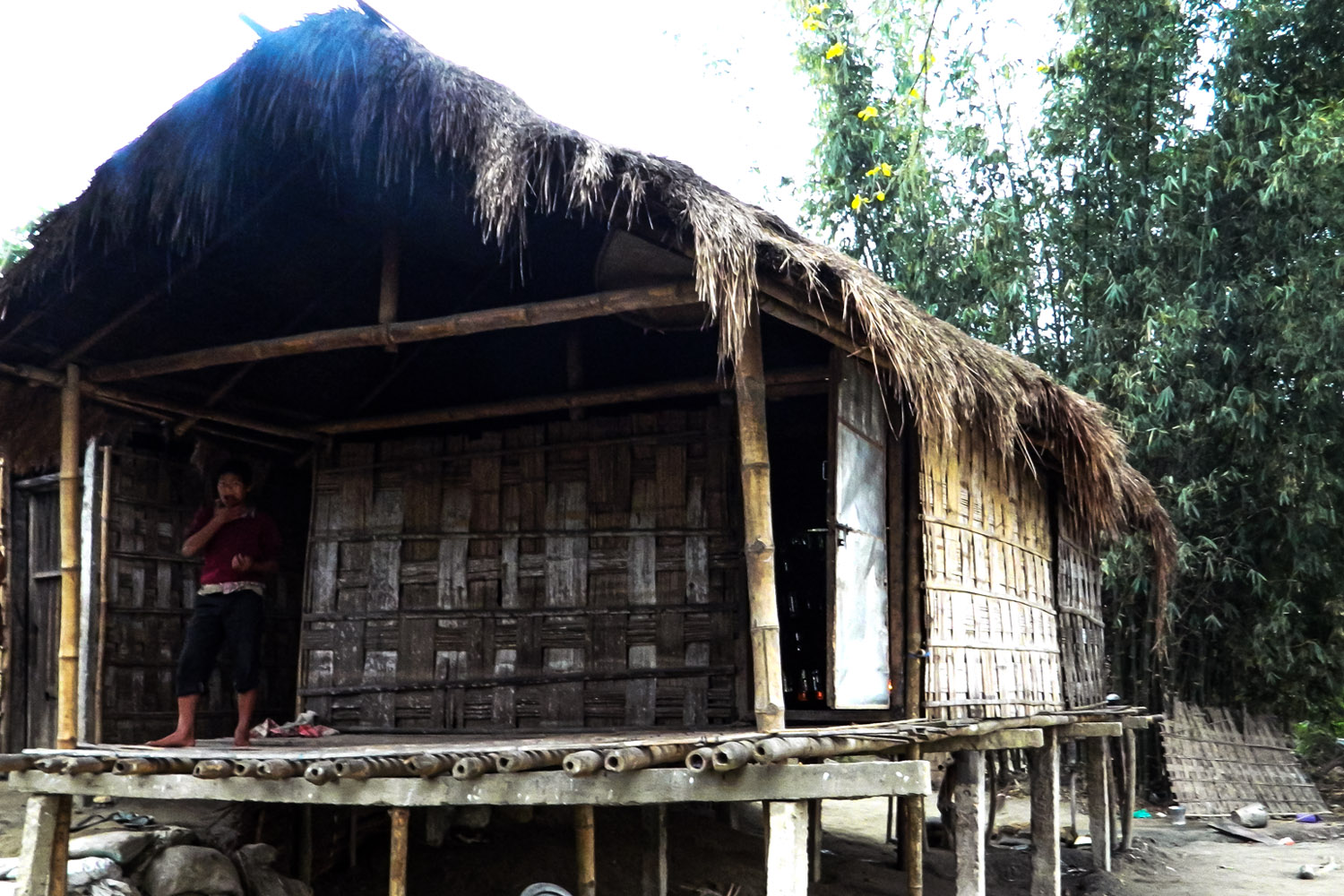
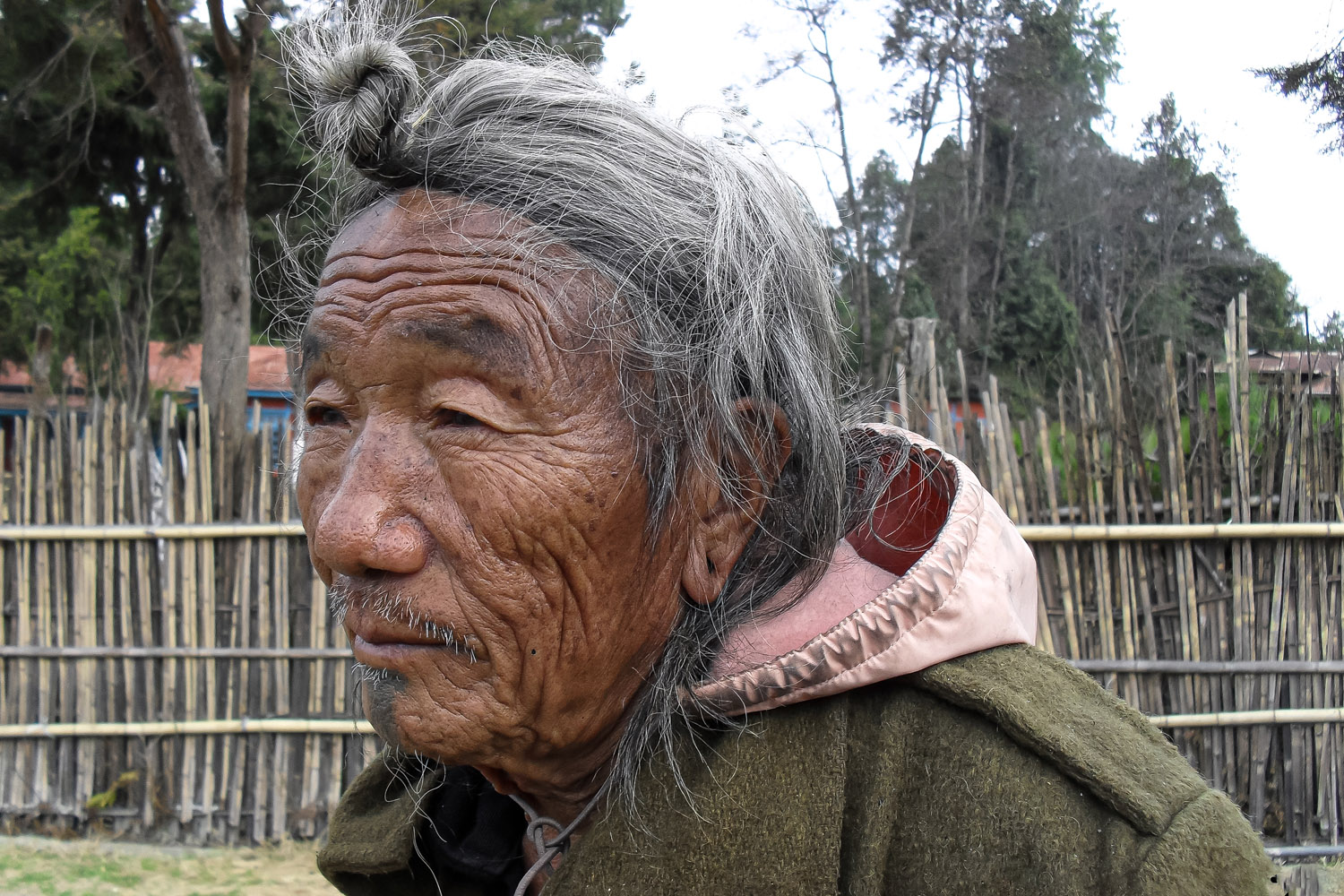
Ziro valley is home to the Apatani, a settled hill community living in a broad, almost level basin ringed by low pine clad hills. Their compact villages of stilted bamboo houses overlook meticulously terraced paddy fields where rice and fish are cultivated together, sustaining a relatively stable agrarian economy. Apatani culture revolves around nature worship, priest led rituals, and strong village councils that regulate social life and land use. Older men once wore hair in topknots and facial tattoos, while elder women were marked by bold facial tattoos and wooden nose plugs, a striking feature that distinguishes them from neighbouring tribes.
Overnight at hotel.
Day 12 – Ziro
Full-day, explore more Apatani tribal villages in the surrounding areas.
Overnight at hotel.
Day 13 – Ziro to Dibrugarh
After a leisurely morning drive back to Dibrugarh (250 Km).
Arrive Dibrugarh and check-in at hotel with rest of the day at leisure for rest.
Overnight at hotel.
Day 14 – Dibrugarh to Mon (Via Shivsagar)
Morning, drive to Mon (185 Km) in Nagaland home to Konyak Nagas visiting old capital of Ahom dynasty Shivsagar enroute.
About 85 Kms from Dibrugarh is Shivsagar. Once the capital of the Ahom kingdom, it is vital for its rich history, politics, and culture, with iconic tanks, temples, and palaces. Its landscape is flat to gently undulating, featuring lush greenery, historic monuments, tea gardens, lakes, and wetlands, all at an altitude of 86–98 meters above sea level, making it a scenic heritage destination.
Visit Shiv Dol temple complex, Rang Ghar and Talatal Ghar here.
Shiv Dol is a remarkable 18th century temple that encapsulates the architectural, religious, and historical legacy of the Ahom kingdom, making it a must-visit destination in Northeast India. Famous for being the tallest Shiva temple in India and for its exquisite Ahom-style architecture, which blends local Assamese elements with traditional Hindu temple design. The temple’s unique features, such as the golden dome and the reversed Shiva Linga, attract both pilgrims and tourists. The surrounding Sivasagar Tank and the subsidiary temples Vishnudol (dedicated to Vishnu) and Devidol (dedicated to Durga) create a spiritually and culturally rich environment, making it a focal point for religious festivals like Maha Shivaratri and Dol Yatra. Its historical association with the Ahom dynasty and its role in Assam’s cultural heritage further enhance its fame.
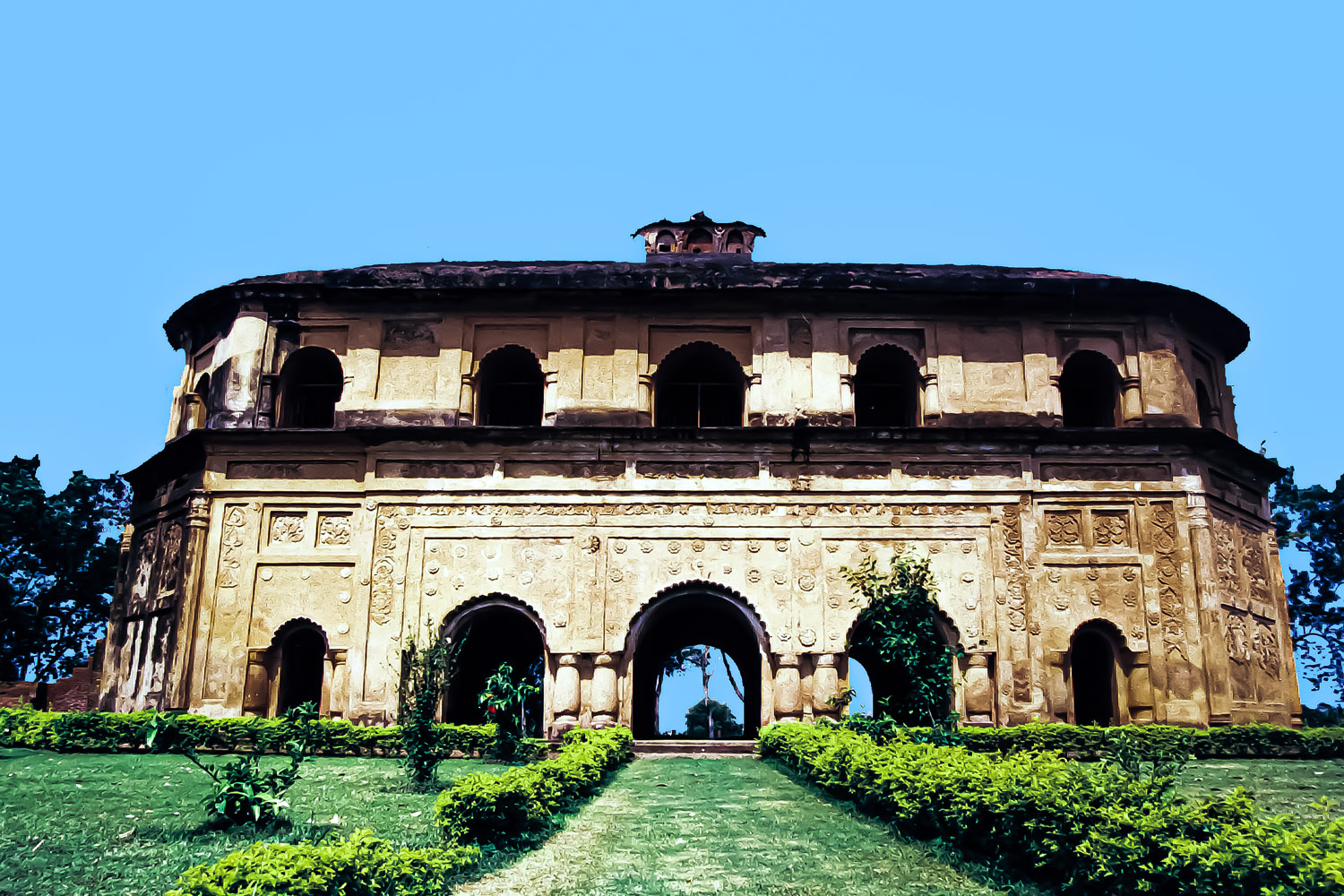
Rang Ghar, the “Colosseum of the East,” is an 18th-century Ahom royal sports pavilion, Asia’s oldest surviving amphitheatre-style structure. Originally built in 1696 as a bamboo-wood pavilion in Rangpur capital, it was rebuilt in brick (1744–1751), showcasing Ahom architectural peak. The 10m-high, two-storied edifice uses baked bricks with rice-egg mortar and an inverted longboat roof with stone crocodiles. From its plinth, kings watched buffalo fights on Rupahi Pathar.
Talatal Ghar, the largest 18th-century Ahom monument, merges royal palace and military base. Construction began in the late 17th–early 18th century as a semi-permanent palace in the new capital Rangpur, and it was later rebuilt and expanded in brick around 1765 as a fortified headquarters during conflicts with neighbouring powers. This seven-story complex—three underground, four above—uses rice-egg cement, with corridors, stables, Puja Ghar, and secret tunnels (3 km to Dikhow River, 16 km to Garhgaon). Amid valley lawns, its Tai Ahom-Indo-Islamic fusion symbolizes engineering brilliance.
Arrive Mon by early afternoon with rest of the day at leisure or free for optional activities.
Overnight at hotel.
Day 15 – Mon
Morning, depart by road for a day excursion to Longwa village (42 Km one way). Longwa is a dramatic border village in Mon district, where the ridge literally straddles India and Myanmar and forms one of the most atmospheric Konyak Naga settlements to visit in Northeast India. It is famous for its Angh (king), tattooed ex–headhunter warriors, traditional morungs, and sweeping views of forested hills rolling into Myanmar.
Highlights of the excursion to Longwa are, a visit to Angh’s (king) house, and of course village with traditional morung (boy’s dormitory), Tattooed elders, gunsmiths etc.
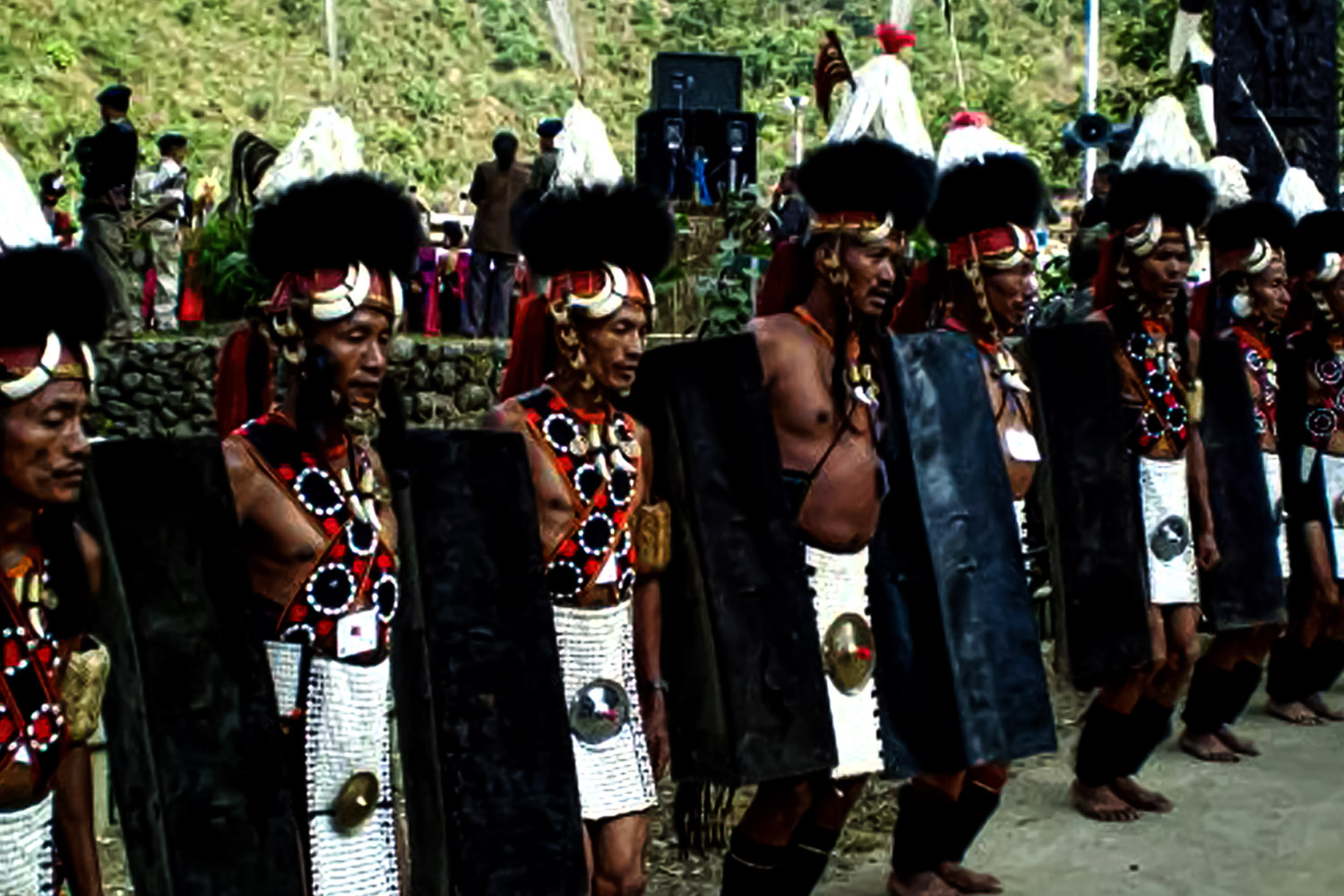
Angh’s longhouse, split by the India-Myanmar border, festooned with buffalo horns, skulls, carvings, weapons, and photos—anchors this atmospheric Konyak Naga village. Traditional morungs flaunt carved pillars, massive log-drums, and spaces echoing warrior training, tribal law, crafts, and folklore. Gunsmiths forge old-style guns and daos in smoky workshops; stroll lanes past stilted houses, kitchen fires, terraced fields, and Myanmar-spanning viewpoints. Artisans hawk wood carvings, spears, pipes, baskets, and beadwork jewelry. The Angh rules cross-border realms with hearthside rituals and headhunting yarns. Konyaks, fierce ex-headhunters, weave jhum farming, tattoos, feathered gear, and Christianity into ridge-top life. Homestays and treks unlock this vibrant "Wild East" gem.
Time permitting also visit Shangkhachingnyu village to learn more about this tribe.
Return to Mon by late afternoon.
Overnight at hotel.
Day 16 – Mon to Mokokchung
Morning drive to Mokokchung, (264 Km) the land of Ao Naga, the largest tribal group in Nagaland.
Arrive Mokokchung by late afternoon or early evening and check in at your hotel/ homestay with rest of the day at leisure.
Mokokchung, a charming hill town in northern Nagaland and the cultural heartland of the Ao Naga, rests amid layered green ridges and cool mountain air. Its panoramic landscapes, misty slopes, and ridge‑top views make it a serene yet vibrant highland retreat.
Overnight at hotel/ homestay.
Day 17 – Mokokchung
Full-day, explore Ao Naga villages in the surroundings to learn more about the history, culture, and life of this tribe.
The Ao Nagas forms the cultural heart of Nagaland, centred in Mokokchung district, where villages like Mopungchuket, Ungma, and Longkhum breathe ancient legends. Tracing lineage to the mythic Longterok migrations, they built vibrant village-republics bound by clans, customary laws, morungs, log-drums, and hillside jhum fields.
Missionary encounters in the early 19th century ushered in Christianity and literacy, transforming Mokokchung into an intellectual nucleus. Feasts of merit, symbolic shawls, vivid woodwork, and timeless love tales like Jina-Etiben shape their cultural imagination. Visionary Ao leaders helped define modern Naga identity—rooted in tradition yet attuned to change.
Renowned for exquisite bamboo craft, colourful shawls and wraparounds, intricate headgear, and fine artistry, the Ao Nagas embody the creative spirit of Nagaland’s living heritage.
Overnight at hotel.
Day 18 – Mokokchung to Touphema
Morning drive to Touphema (120 Km) visiting Ungma the oldest and the largest Ao Naga village enroute.
Ungma, known as the oldest and largest Ao Naga village, sits just a short drive from Mokokchung, offering a clear glimpse into the tribe’s roots and living traditions. Resting on a ridge surrounded by forests and terraced slopes, the village blends old morungs, echoing log‑drums, and modern houses in a peaceful setting. Believed to be the first Ao settlement after the Chungliyimti migration, Ungma remains the cultural heart of the Ao people. Everyday scenes of shawl weaving, woodcraft, and community life show how tradition, faith, and modern living blend gracefully in Nagaland’s enduring heritage.
Arrive Touphema and check in at the hotel.
Afternoon explore the village walking through Touphema’s cluster of traditional Angami‑style huts with tall roofs, carved posts and hearths, echoing real village homes. The small museum displays Angami ornaments, tools and textiles, offering quick cultural insight. Around the village, scenic trails reveal terraced slopes, kitchen gardens and forested hills. Visitors can enjoy smoked meat lunches, browse bamboo crafts, and on special days, watch folk dances—making a rich, half‑day taste of Angami life.
Overnight at hotel.
Day 19 – Touphema to Kohima
Morning explore the village little more to know more about this tribe.
Early afternoon drive to Kohima (40 Km) visit the State Museum in Kohima town.
Arrive Kohima and check in at hotel with rest of the day at leisure or free for optional activities.
Overnight at hotel.
Day 20 – Kohima
Morning, proceed on an excursion to Khonoma village (20 Km/ one way)
Khonoma Village: Nestled amidst lush green hills and dense forests about 20 Km west of Kohima city, this picturesque hamlet known as “Asia’s first Green Village” is famous for its sustainable living. Though it is defined today by a picturesque landscape with terraced fields, forest, and hills, Khonoma has witnessed bloody battles of Angami Naga and British conflict during 19th- century. Remnants of its fortifications and historical landmarks, such as the Khonoma Fort, narrate tales of bravery and resilience.
Afternoon visit one of the most historic monuments of Kohima the War Cemetery and Kohima Cathedral.
World War II Cemetery: Located at the Garrison Hill in the city this memorial contents graves of 1400 soldiers from various countries who laid their lives in one of the fiercest battles fought between the Allied Forces and the Japanese in 1944 during World War II. Its layout includes terraced lawns, flowerbeds, and a Cross of Sacrifice, blending them with the topography of the place. The iconic epitaph at the cemetery reads: "When You Go Home, Tell Them Of Us And Say, For Your Tomorrow, We Gave Our Today."
Kohima Cathedral: Located on Aradura Hill above Kohima city, this cathedral also known as the Cathedral of Mary Help of Christians was built in memory of soldiers of both Japanese and Allied soldiers who died during the Battle of Kohima in World War II. Built in 1991 a unique aspect of its architecture is the fusion of modern and traditional Naga designs, symbolizing a blend of faith and local culture. The place also commands a bird-eye view of Kohima city and surrounding hills.
Overnight at hotel.
Day 21 – Kohima
Morning, proceed on a half-day excursion to Kasima Village (12 Km/ one way).
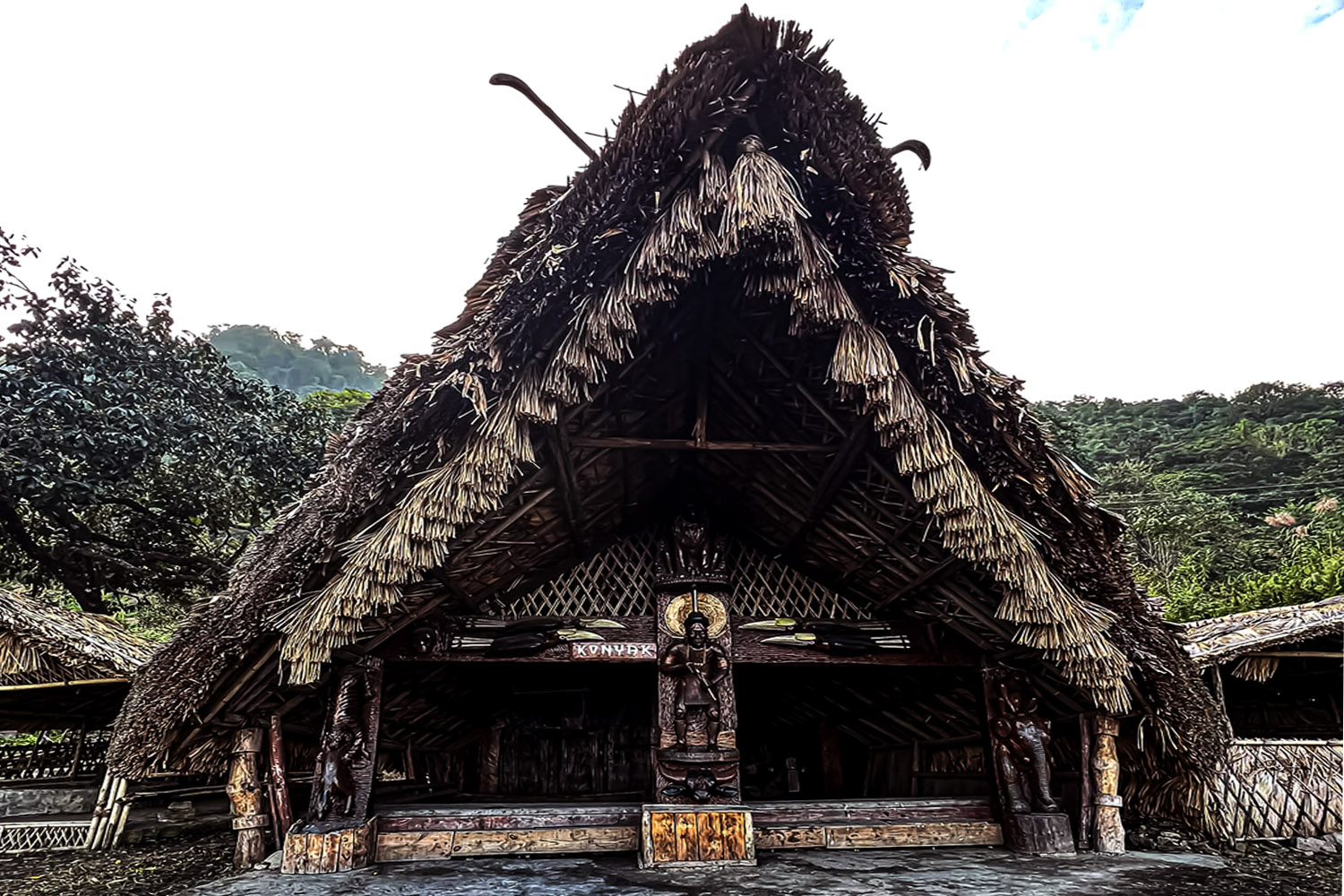
Kasima Heritage Village: A cultural hotspot that showcases the rich traditions and vibrant lifestyle of Nagaland’s 17 tribes, this model village was started in 2003 with the vision of preserving and promoting Naga culture while fostering unity among the tribes. Explore the traditional tribal huts (or Morungs as they call), each uniquely designed to represent a different Naga tribe with structures displaying intricate carvings, traditional artifacts, and clan symbols. The Kasima Heritage Village is the official venue for the world-famous Hornbill Festival, held annually in December showcasing the diverse cultural heritage of the region.
Rest of the day at leisure to explore the place on your own.
Overnight at hotel.
Day 22 – Kohima to Delhi and Depart
Morning drive to Dimapur airport (64 Km) to board the flight for Delhi. Arrive Delhi and connect the international flight.
Site by Naulak Web Design.